Wednesday, March 11, 2015

Fox Plots 'Empire' Season 2: Lee Daniels Courts Oprah, Pushes for Less "Opulence"

This story first appeared in the March 20 issue of The Hollywood Reporter magazine.
Every Wednesday afternoon, FOX Broadcasting's David Madden offers himself a reminder: "Gravity exists," he says. "This is going to be the week that Empire levels out or maybe even falls a bit."
But for more than two months, the newly installed entertainment president's cautionary message hasn't proved necessary. Despite pre-launch predictions of a 1.8 rating in the coveted 18-to-49 demographic, the hip-hop-themed drama bowed to a 3.8 in early January — and has grown more than 50 percent during the eight weeks since, a greater increase than any other new broadcast series in a decade. Empire's March 4 episode notched a staggering 5.8 rating (14.3 million total viewers), making it the top-rated drama on broadcast television. Now, as the series co-creator Lee Daniels describes as "black Dynasty" is set to wrap its first season March 18, the fourth-place network — down nearly 25 percent this season, even withEmpire — is shifting its focus to sustaining the show's megahit status.
Partner Columbia Records dropped Empire's first album, featuring songs by season one guest stars Jennifer Hudson and Mary J. Blige, on March 10, and Fox will kick off the show's Emmy campaign with a screening and Q&A at the TV Academy two days later. While execs weigh other key decisions, including whether to air Empire repeats this summer, they've been pushing heavily for viewers to catch up on Hulu and Fox Now, where the pilot continues to draw 100,000 views a day. (Studio 20th TV already has suitors sniffing around about syndication opportunities, but no formal discussions have begun, according to an insider.)
Also being discussed internally is season two timing, with Madden noting he "wouldn't be surprised" to see the series come back before midseason. (Fox has struggled to retain viewers after long hiatuses for The Following and Sleepy Hollow and historically has flatlined in the fall ratings.) What's more, he says Empire will return with more than the first season's 12 episodes, though how many more is a topic of much debate. Co-creator Danny Strongsays he's OK with an increased order — given the nature of the storytelling and original music, it won't be a full 22 — but Daniels is vocal about his desire to stay at 12, even suggesting he'll fight an increase: "Bring it on," he tells THR.
What Empire won't have when it returns to Fox next season is a collection of soapy companion shows, the byproduct of a development season already underway when Empirelaunched big. Instead, the network's batch of pilots is more a reflection of fall breakoutGotham, with a handful of genre offshoots, including Minority Report and Frankenstein, in the works. "As we start the next development season in the summer, the impact of Empire will be very much present," says Madden, careful to add, "I'd love us to have shows that satisfy the same audience that we're drawing with Empire, but we also can't just live off of one item on the menu."
Looking forward, a cast musical tour a la Glee is on the table (though it has been deemed infeasible this hiatus), and an international push is key to Empire's growth strategy. Although the series has generated enthusiasm overseas, Marion Edwards, 20th Century Fox's president of international TV, notes that took time and ratings success that was impossible to ignore. In fact, when Edwards began screening the pilot for international buyers last spring, she was surprised by the widespread disinterest. "They thought the show was cast with people who potentially couldn't work in their markets," she says, referring to the show's African-American cast led by Oscar nominees Terrence Howard and Taraji P. Henson. "And music is hard because you can't dub it."
But that international interest level began to increase considerably when buyers saw the amount of marketing muscle Fox had put behind the show (Empire and Gotham consumed the lion's share of the network's marketing dollars this season) and then the eye-popping ratings it began to garner. By week three, Edwards had multiple broadcasters in key territories eager to get a deal done. She cites the U.K. market, often a strong indicator of European heat, by way of example: "We had no offer and no interest [prelaunch], and now we have three broadcasters vying to get it."
Although the creative team is set to take a break before season two planning begins in earnest, Strong and showrunner Ilene Chaiken have been busy bulking up the writing staff. "I wanted to bring in some playwrights because we have these delicious soap turns but we also have very layered character development," says Strong, who has been courting emerging African-American talent. Meanwhile, Daniels is in L.A. in mid-March and intends to share his ideas. Among them: He'd like to incorporate more of the poorer-class African-American experience into the storyline. "I think we've seen the opulence," he says, "but now we have to go back to where they come from."
The producers likely will discuss the deluge of requests they've received from potential guest stars and directors, too. Daniels has been most struck by Spike Lee, who he says has reached out about helming an episode. "That's when I realized what a beast Danny and I have created," says Daniels. (With more famous names expected for season two, there figures to be more offscreen headaches as well. According to multiple insiders, Macy Gray's season one arc was scrapped after she exhibited erratic behavior on the show's Chicago set.) The producers, who also include Imagine's Brian Grazer, have made approaches, too. Daniels cops to logging multiple calls to pal Oprah Winfrey to try to get her on the show.
"I tell him: 'Lee, it's not enough that you've taken every viewer possible on Wednesday night. Now you want me to leave my own network?' " says Winfrey, to which Daniels howls with laughter, "I'm wearing her down!"

Fight Between Apple and Spotify Could Change Digital Music; Labels Said to Reject Pricing Below $9.99


A renewed focus on the value of music comes as a transition point for the record business. 


Image result for spotify apple

Rob Wells, Universal Music Group's president of digital who brokered deals with "freemium" services like Spotify, left the company in late February. Now the company is rethinking the value of unlimited free streaming, according to a label source. At the same time, Apple's upcoming subscription service, slated for a June launch according to an industry source and media reports, will forego the freemium model for a paid-only approach. It's an approach Beats Music co-founder Jimmy Iovine, an executive at Apple since the acquisition of Beats Electronics, has consistently favored.
Negotiatons for Apple's upcoming subscription service are evidence labels are standing firm on pricing. Industry sources say Apple has backed down from its effort to lower monthly pricing for its subscription service to $7.99 from $9.99. Apple would have to absorb the loss if it sets a price lower than the standard $9.99. 
Money bagsFew specifics about Apple's subscription service are known at this time. It is widely believed that Apple will replace the Beats Music name with the iTunes brand. Label insiders say Apple has not revealed features or given demos. There is no indication if Apple will integrate iTunes Radio with a subscription service. But these insiders believe Apple is confident it can create a service that stands out from competitors and delivers enough value that consumers will pay the full price.
Apple is said to be talking to labels and artists about exclusives for its upcoming subscription service. An industry source dismisses rumors that Apple will be able to outmaneuver and outbid its competitors on exclusives for most key releases. "Apple is one of the biggest companies in the world. If they want exclusive content, they're going to have to get out the checkbook."
The music industry eagerly awaits Apple's reboot of Beats Music, and the timing couldn't be more perfect. The showdown between Apple's pay-only business model and Spotify's freemium model could change how people think about using free music to get paid music.
Industry sentiment about free music is years in the making. The previous decade was marked by brutal declines in revenue that reshaped companies -- and the entire structure of the music business. iTunes provided a helpful transition to digital formats. Fives years later, services like Spotify won labels' over, with a pitch to both generate revenue and reduce piracy. Now there are dozens of other streaming services with licensed content.
Image result for spotify appleThere has been a frenzy of licensing activity as labels became more flexible in their terms with digital services. "The last two or three years has been about stopping the [sales] decline and creating as many platforms and as many services and opportunities to capture money," Universal Music Group chiefLucian Grainge said last year at a Wall Street Journal conference.
Now the smoke is clearing and different attitudes are forming. Some labels feel Spotify should have more than 15 million subscribers, sources tell Billboard. Apple's pay-only service could be a turning point. If Apple is successful in attracting large numbers of subscribers without unlimited, or at least significant, free listening, Spotify's business model could fall under more scrutiny. "Spotify is good at giving it away for free, but it's bad at getting people to pay for it," says an industry source.
The complaints from artists have grown louder. Artists have been vocal about streaming services' royalties and the lack of transparency in the licensing terms. The freemium model itself has come under fire. Taylor Swift and Bjork have recently expressed their unwillingness to make music available to a subscription service's ad-supported tier. "This streaming thing just does not feel right. I don't know why, but it just seems insane," Bjork told Fast Company last month.
Prompted by the public sparring between Taylor Swift and Spotify, Warner Music Group CEO Stephen Cooper brought up the topic in an earnings call in December. He voiced support for ad-supported streaming but warned that services with a "freemium" model -- the object of Swift's scorn -- must clearly differentiate the benefits of the paid and ad-supported tiers.
Spotify has long taken the positioon it ad-supported tier is an effective way to acquire customers. Four in five subscribers comes from the ad-supported service, says Jonathan Prince, Spotify's global head of communications and public policy.
Indeed, Spotify's freemium approach has allowed the company to scale far better than its competitors. Second place Deezer's 6 million subscribers and 16 million monthly listeners are well behind Spotify's 15 million and 60 million, respectively. Rhapsody, which has a paid-only model, reached 2.5 million subscriber last month.
Prince also argues Spotify brings in consumers who hadn't previously paid for music. As for the worry that Spotify is eating into download sales, Prince says Spotify's internal research shows only 12% of former iTunes users use Spotify. "We're on the same page as the labels in wanting to rebuild the music industry," he says.
One option is to implement listening caps. Spotify had listening caps in place in Europe until January 2014 and had various restrictions in place in various countries. (For example, until March 2013 free users in the U.K. could play an individual song up to 5 times.) Sources say labels believe listening caps would help differentiate between free and paid services.
Image result for spotifyBut labels are also realistic about the need to provide a free service. "People don't think you can just turn it off," says a label source. As Cooper said in December, a free tier can be an effective conduit to subscriptions. And free streaming has undoubtedly helped reduce the number of people that turn to illegal channels. There is ample research -- some by Spotify -- that shows music piracy has declined in many countries.
There's also an element of geopolitics at play. A weakened Spotify could help create a more powerful Apple subscription service. That would remove the comfortable, valuable counterweight to Apple that labels don't have in the digital download space. There's even some doubt that Apple is out to beat Spotify rather than grow the music subscription marketplace. "If they're out to kill Spotify, it's news to us," says an industry source. "And it's the last thing we want. We want Spotify to be a strong competitor."

Tuesday, March 10, 2015

(Editorial) 5 Ways To Piss Off An Old School Hip-Hop Head

by  

Hip-Hop is in a whole new world now, even though the 80’s and 90’s are still met with fond recollections of a Golden Era long gone. 

The Hip-Hop heads of that era are now in their 30’s, 40’s and 50’s…or older. And these folks, by and large, are unhappy with the state of affairs in the rap game. We’ve seen this play out in a number of ways. We thought we’d run down a list of the primary things that annoy Older G’z about the present state of Hip-Hop.
1) “My Generation Is Doper Than The 90’s”

The main thing Old Heads take issue with the present day of Rap is that is ain’t like the good old days. Most forget that there was a plethora of garbage floating around the Hip-Hop universe at every turn. And, make no mistake…each era tends to like their own era. So, buck…don’t you ever think about saying Drake is better than Jay unless you want a real serious argument on your hands.
2) “On Fleek”
fleek coco
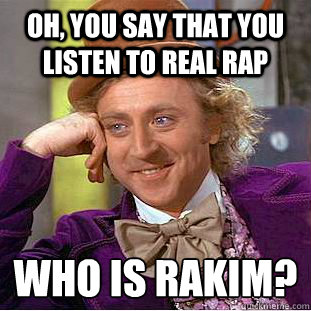
Oh, you say that you listen to real rap Who is Rakim?   Condescending WonkaJust don’t say “on fleek” to anybody that has a real sense of Hip-Hop Culture from back in the day or they will likely roll their eyes like a pair of dice as they write you off for dead.

3) “Who is (Fill In The Blank With A Legend)?”
Please. You may not care , young buck. And, to some extent, that is OK. However, it is best to know who the hell the legends are in the culture of Hip-Hop. That’s like being a revolutionary and not knowing Malcolm X, but not Elijah Muhammad.

4) Gay-Like Hip-Hop
In the mainstream of Rap music, there have been more and more rappers with a penchant for traditional female tendencies. Back in their day, it was ok for acts like TLC and Boss to take their fashion cues from men. With Young Thug, Daylyte and a few choice others, they have flirted with gender-bending in rap, much to the chagrin of your average old head.

5) The Belief That ANY Rapper Is “Real” Today

The OG’s may OD on love (often mistranslated as hate) for current rap music, but a lot of that is because their era was before the culture was overrun with money and corporate interests. These older heads have a point. You could do like Suge, Just Ice, or Treach and there was no TMZ, Hip-Hop police or social media to blow up the spot. The “real” stayed in the streets. The crazy thing is, a lot of the young boys want to earn their stripes or are simply living the life. And the results are disastrous. Just look at the incarnation rate in the last few years. Anyway….yeah.

UPDATE: Ex-Jets RB Chris Johnson Shot In Arm, Is In Stable Condition

Chris Johnson is in stable condition after getting injured during drive-by

Image result for chris johnson jetsThere’s very little information available, but what we do know is that during a fatal drive-by shooting in which one person was killed, former Jets and Tennessee Titans running back Chris Johnson was shot. He is currently in stable condition according to multiple reports.
The shooting took place in Orlando, FL, and according to an Orlando Sentinelreport, at about 4:09 this morning, an unidentified vehicle pulled up beside the Jeep Johnson was riding in and opened fire. Authorities arrived on the scene shortly after to find the driver–Dreekins Johnson–deceased, and Chris and a third passenger on the sidewalk tending to gunshot injuries.

TOP STORY: Angie Stone Arrested For Knocking Out Daughter’s Teeth

angiestonep

Former rapper-turned R&B diva Angie Stone has been arrested after she allegedly knocked out her daughter’s front teeth.

She has been charged with domestic aggravated assault.
Police charge that the singer struck her 30-year-old daughter with a metal stand, taking out her front teeth. Angie has claimed self defense, alleging that her child punched her first in an incident that went down Monday night.
Police have not indicated who threw the first blow.
The violent fracas started when Angie demanded her daughter, Diamond, clean up and get her children under control in her home.
“Ms. Diamond Stone then went on to state that Ms. Angie Stone started (getting) in her face, telling her she needed to leave because she is tired (of) her,” police said in the report. “Ms. Diamond Stone then stated her and Ms. Angie Stone started to argue, and that’s when a physical altercation started to occur.” (Soure: Atlanta Journal Constitution)
Angie Stone, 53, reportedly told police she didn’t realize she hit her daughter.
told police she did not know she hit her daughter with a metal stand.
“Once she realized this, she quickly put the stand down and attempted to get away from Ms. Diamond Stone. Ms. Angie Stone then stated while she tried to get away, Ms. Diamond Stone continued to come after her as if to strike her again but stated that Ms. Blondy Chisolm came to break up the fight.”
Blondy Chisolm is a former rapper as well, who once rapped with Angie Stone in the Sugar Hill Records group The Sequence.
Diamond says she walked away from her mother and was the  hit in the face. She called the police.
Both went to the police, but Diamond Stone was released with no charges. 

(EXCLUSIVE) Jurors hit Robin Thicke and Pharrell Williams with $7.4-million verdict

Federal jury found Tuesday that the 2013 hit song "Blurred Lines" infringed on the Marvin Gaye chart-topper "Got to Give It Up," awarding nearly $7.4 million to Gaye's children.

Good artists borrow. Great artists steal. On Tuesday (March 10), a California federal jury delivered its own message to artists everywhere that inspiration can rise to copyright infringement.
nona gaye after blurred lines trial verdict march 10 2015The verdict was reached after eight days of trial examining whether Robin Thicke's and Pharrell Williams' "Blurred Lines," one of the most successful songs of the young century, was improperly drawn from a soulful hallmark from the prior one: Marvin Gaye's 1977 hit "Got to Give It Up." Ultimately, a jury comprised of five women and three men heard dueling opinions regarding "Blurred Lines" and decided to rule in the Gaye family's favor.
The hardly predictable outcome over a song that made more than $16 million in profits will resonate in the music industry, where copyright lawsuits are commonplace but few ever make it to trial. Most never get past the summary-judgment phase, because judges carefully draw the line on any lawsuits alleging misappropriation of non-protectable ideas. The highest-profile disputes -- like the one between Tom Petty and Sam Smith over "Stay With Me" -- usually settle. Not only did the "Blurred Lines" case go the distance, both sides brought esteemed entertainment litigators to convince the jury.
Howard King, representing Thicke, Williams and rapper T.I. (a.k.a. Clifford Harris Jr.), spoke about how artists need wide berth in their creative pursuits. During opening arguments, he told the jury, "We're going to show you what you already know: that no one owns a genre or a style or a groove. To be inspired by Marvin Gaye is an honorable thing."
Over the next week-and-a-half, King would execute a two-pronged strategy: First, he emphasized that Frankie and Nona Gaye only owned compositional elements in the "Got to Give It Up" sheet music, leaving out more recognizable elements of the recording like the percussion and singing. Second, he had witnesses testifying both to the differences of "Blurred Lines" and "Got to Give It Up" as well as the similarities in other famous songs.
The case has been tough on Thicke, thanks to depositions revealing he lied in media interviews and was drunk and high on Vicodin. But the singer attempted to do himself a favor by showcasing that songs can be stitched together with ease. On the witness stand, he sang a medley of U2's "With or Without You," theBeatles' "Let It Be," Alphaville's "Forever Young," Bob Marley's "No Woman No Cry" and Michael Jackson's "Man in the Mirror."
Williams also testified about his song-creation process, admitting to jurors that "Blurred Lines" channels "that '70s feeling" and that he looked up to Gaye, but that to feel, isn't copyright infringement. "The last thing you want to do as a creator is take something of someone else's when you love him," said Williams, expressing a point-of-view that's in contrast to the maxim that good artists borrow and great artists steal.

Thicke said in several interviews that he suggested to Williams that they write something like "Got to Give It Up," and Williams has said he was "trying to pretend" he was Gaye when he wrote it.

Image result for marvin gaye
Richard Busch, attorney for the Gayes, appeared to know that he'd need to overcome the celebrity charisma of his counterparts. "They will smile at you and they will be charming," he said in opening arguments. "Keep one thing in mind: They are professional performers."
The Gaye family was handicapped by U.S. District Judge John Kronstadt's decision to preclude use at trial of the original sound recording of "Got to Give It Up" because Gaye's copyrights on the song were limited to the sheet-music compositions. Before the trial began, Busch wondered whether his side would get a fair trial, and while the judge eventually allowed a stripped-down version of Gaye's song to be played for the jury's ears, the attorney was disturbed by comments made by the Thicke side that he argued had "poisoned" the trial. The judge dismissed those concerns. Any lingering unhappiness over the judge's decision leading to the jury's verdict will likely be taken on appeal.
To demonstrate copyright infringement, Busch instead leaned on the musicologists, who testified of similarities in signature phrases, hook, keyboard-bass interplay, lyrics and theme of the songs. Although "Blurred Lines" was the primary ticket, the Gaye family also attempted to prove that Thicke's "Love After War" was an infringement of Gaye's "After the Dance" too.
Then, there was the rare peek at the financial success of "Blurred Lines," as the Gaye family made their case for damages. Busch had accounting experts speak about all the money made -- including $5.6 million in profits to Thicke, $5.2 million to Williams and $700K to T.I. and the rest of the $16.7 million in overall profits to record companies Interscope, UMG Distribution and Star Trak. The Gayes also wanted some of the $11 million in touring income attributable to "Blurred Lines" success as well as money for overhead costs and statutory damages for willful infringement.
BB07 Blurred Lines Trial
All told, the Gaye family was seeking more than $25 million -- a mammoth demand that would shatter the song plagiarism high-water mark of $5.4 million that a California court ordered Michael Bolton and Sony to pay two decades ago for infringing the Isley Brothers' "Love Is a Wonderful Thing."
In closing arguments, Busch raised the issue of Thicke's credibility, telling jurors, "What it boils down to is 'Yes, we copied. Yes, we took it. Yes, we lied about it. Yes, we changed our story every time'... It boils down to this: Who do you believe?... Are you going to believe Robin Thicke, who told us all he's not an honest person?"
King offered a rebuttal. "Why would Mr. Williams need to copy anyone to create a hit?" he asked the jury. "Why would Mr. Thicke and Mr. Williams endure a proceeding like this, where their personal financial details are revealed to the world?"